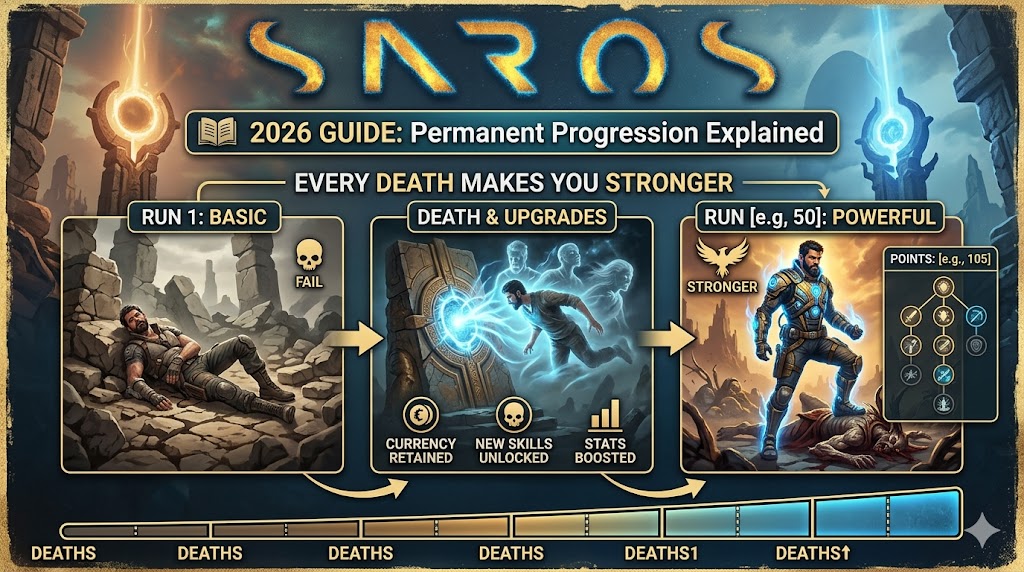
Saros: How Permanent Progression Works — Every Death Makes You Stronger
The thing that kept me from truly loving Returnal was the reset. Two hours into a flawless run, one bad dodge against Nemesis, and everything was gone. Weapons, artifacts, consumables, progress. All of it wiped. Start over with a pistol. Try again. Housemarque clearly heard that feedback, because Saros rebuilds the entire progression philosophy from the ground up.
In Saros, every single death feeds your next attempt. Not metaphorically. Not in some vague “you learned something” sense. Structurally. Mechanically. You keep your weapons. You keep your upgrade currency. You keep access to every biome you have cleared. The Armor Matrix skill tree gives you permanent stat boosts that survive death. And the Second Chance system means your first death in a run is not even a death at all.
This is the single biggest change between Saros and its predecessor, and it fundamentally alters how the game feels to play. Understanding saros permanent progression before you start your first run will save you hours of confusion and help you invest your resources wisely from the very beginning. I have been studying every preview, every developer interview, and every hands-on impression available, and this guide lays out exactly how every system connects.
For a broader look at how Saros compares to Returnal across all its systems, we published a full side-by-side comparison that covers combat, scale, and accessibility differences.
Table of Contents
- Why Saros Is a Roguelite, Not a Roguelike
- Lucenite: The Currency That Survives Death
- The Armor Matrix Skill Tree Explained
- Weapon Retention: Keep What You Find
- The Passage: Your Permanent Home Base
- Second Chance: Your First Death Does Not Count
- The World Dial and Biome Routing
- How the Eclipse Feeds Progression
- Practical Progression Strategy
- FAQ
Why Saros Is a Roguelite, Not a Roguelike
The distinction matters more than people think. A roguelike resets nearly everything on death. Returnal was essentially a roguelike at launch, with only a handful of permanent unlocks like traversal abilities and ether (a limited currency). A roguelite lets you carry meaningful upgrades across runs, so that even a failed attempt makes future attempts easier.
Saros lands firmly in the roguelite camp. According to a detailed breakdown by GamingBolt, the game features “permanent upgrades to improve Arjun’s stats” through a system called the Armor Matrix, along with weapon retention and currency that persists between runs. The official Saros wiki describes this shift plainly: “Saros is built around coming back stronger after every failure.”
This is not just a quality of life improvement. It changes the emotional texture of the game. In Returnal, a death felt punishing. In Saros, a death still stings, but it also deposits resources into your long-term progression. You lost the run, but you gained Lucenite, you kept your weapons, and you unlocked new nodes in the Armor Matrix. The sting fades quickly because you can immediately see how the failed run made you stronger.
Lucenite: The Currency That Survives Death
Lucenite is the primary progression currency in Saros, and it persists through death. Every enemy you kill, every chest you open, every biome objective you complete earns you Lucenite. When you die, the Lucenite you collected during that run carries over to The Passage, where you spend it on permanent upgrades.
This is a massive departure from Returnal, where the main currency (Obolites) vanished on death. Only Ether survived, and it was capped at a small amount with limited uses. Lucenite has no such cap, and it serves as the backbone of the entire upgrade economy.
According to hands-on reports from Geek Culture, “all currency picked up when Eclipse is in effect is also increased.” This means that triggering the optional Eclipse event during a run substantially boosts your Lucenite gains, creating a risk-reward loop where harder combat directly translates to faster permanent progression. I will cover how to use this strategically in the Eclipse section below.
The takeaway is simple. Every run earns Lucenite. Every death preserves it. Every visit to The Passage lets you spend it on something that makes you permanently stronger.
The Armor Matrix Skill Tree Explained
The Armor Matrix is your permanent upgrade tree, and it is the heart of Saros’s progression system. You access it at The Passage between runs, and every upgrade you purchase persists forever.
Based on confirmed details from GamingBolt, the Armor Matrix has three core stat branches:
| Stat | What It Upgrades | Why It Matters |
|---|---|---|
| Resilience | Maximum health (integrity) | More health means more room for mistakes. Critical for learning new biomes. |
| Command | Shield duration and absorption efficiency | Directly improves the Soltari Shield, your most important combat tool. |
| Drive | Lucenite gains from all sources | A compounding investment that makes every future run more productive. |
Each branch has multiple tiers, and later tiers cost significantly more Lucenite than early ones. The progression curve is designed so that your first several upgrades come quickly, giving you a noticeable power spike in the early hours, while later upgrades require more investment and reward dedicated play.
Beyond raw stat boosts, the Armor Matrix also unlocks new abilities as you progress deeper into each branch. Specific ability details have not been fully revealed in previews, but developer interviews mention expanded traversal options and combat modifiers that open up as you invest more heavily in a particular stat line.
My Recommended Early Investment Order
Based on everything I have studied about the game’s systems, here is the order I plan to follow on my first runs:
- Drive (first two tiers) to boost Lucenite gains early. This compounds over every future run, so investing here first accelerates everything else.
- Resilience (first three tiers) to build a health buffer for learning new biomes. Dying less means more Lucenite per run.
- Command (first three tiers) to extend shield uptime and improve absorption. Once you are comfortable surviving, this converts your defensive play into offensive output.
- Drive (remaining tiers) to maximize late-game Lucenite income for the expensive final upgrades.
This is speculative until I get my hands on the actual numbers, but the logic is sound for any roguelite with a compounding currency system. If you want deeper context on how the shield benefits from Command upgrades, our Soltari Shield breakdown covers absorption efficiency and energy management in detail.
Weapon Retention: Keep What You Find
This is the change that will make the biggest immediate difference for players coming from Returnal. In that game, dying meant restarting with the basic sidearm every time. It did not matter if you found a perfect Hollowseeker with Portal Beam on the previous run. Gone.
In Saros, collected weapons are retained on death. According to the official Saros wiki, “Once systems open up, collected primary weapons and Power Weapons are retained on death. A weapon that fits your Saros style remains part of your next attempt instead of forcing a full restart.”
This means that finding a strong weapon during a run is a permanent unlock, not a temporary advantage. If you discover a powerful Carcosan shotgun in Biome 3 and then die to the boss, that shotgun is waiting for you when you start your next run. You build a personal arsenal over time, and each run potentially adds to it.
Saros features two weapon categories: Soltari human weapons (standard firearms) and Carcosan alien weapons (exotic options with unique mechanics). Both types are retained. Power Weapons, the special charged attacks fueled by shield absorption, are also retained once found.
This system transforms the psychological experience of each run. In Returnal, finding a great weapon created anxiety because you knew you could lose it. In Saros, finding a great weapon creates excitement because you know you are keeping it forever. That emotional shift is significant, and it makes exploration feel consistently rewarding rather than stressful.
For players who like building out arsenals in other games, our coverage of Crimson Desert’s best weapons shows how another 2026 release handles weapon progression in an open-world context.
The Passage: Your Permanent Home Base
The Passage is Saros’s hub area. It functions as your permanent base of operations between runs, and it is where all persistent systems converge.
From The Passage, you can:
- Access the Armor Matrix to spend Lucenite on permanent upgrades.
- Interact with Soltari’s Primary (a character who manages your progression interface).
- Equip your loadout from retained weapons and Power Weapons.
- Configure the World Dial to select your starting biome.
- Review lore entries and audio logs collected during runs.
The Passage is available from the start of the game, and you return to it automatically after every death. Unlike Returnal’s crash site, which was essentially a static spawn point with minimal functionality, The Passage is a living hub that expands and changes as you progress through the game.
Think of it as your workshop. Every run ends here. Every run starts here. And every time you visit, you have more tools, more weapons, and more upgrades than the last time. That loop of visible, tangible growth is what makes Saros’s progression feel so different from Returnal.
Second Chance: Your First Death Does Not Count
The Second Chance system is Saros’s built-in safety net. When you take lethal damage for the first time in a run, instead of dying and being sent back to The Passage, you are instantly revived with a portion of your health restored.
According to the progression breakdown on the Saros wiki, “First Death triggers Second Chance with immediate revival with partial health.” Your second death in the same run is the real death, the one that sends you back to The Passage and ends the run.
This effectively gives you two lives per run by default. For players who lost countless Returnal runs to a single mistake in a late biome, this is transformative. You get one free pass to learn from a lethal error without losing your entire run.
The Second Chance system can be disabled through Carcosan Modifiers if you want a more punishing experience. This is Housemarque’s elegant solution to the difficulty debate: keep the challenge for those who want it, but give struggling players a safety net that does not require lowering enemy damage or health.
For players who enjoy customizing their difficulty experience, our roundup of the best PC controllers and hall-effect joysticks covers input hardware that can make precise combat timing feel more natural.
The World Dial and Biome Routing
The World Dial is a navigation system at The Passage that lets you select which biome to start from. Once you clear a biome, it is permanently unlocked and you can fast travel to it on future runs without replaying earlier biomes.
This is another direct response to a Returnal pain point. In that game, reaching Biome 5 meant replaying Biome 4 every single time. If you died at the Biome 5 boss, you slogged through Biome 4 again. And again. The repetition eroded the fun of learning new content.
Saros eliminates that friction entirely. Clear Biome 1, unlock it forever. Die in Biome 3, start your next run in Biome 3 if you want to. Or start in Biome 1 to farm Lucenite in easier encounters. Or start in Biome 2 to practice a specific boss. The choice is yours.
The World Dial reportedly also affects the state of the world in some way, though the exact mechanics have not been fully detailed in previews. Based on developer comments in gameplay walkthroughs, the Dial may influence enemy composition, environmental conditions, or available loot tables when you start from a specific biome. This adds strategic depth to run planning that Returnal never had.
How the Eclipse Feeds Progression
The Eclipse is Saros’s optional hard mode trigger, and it ties directly into the progression loop. According to the hands-on preview from Geek Culture, “all currency picked up when Eclipse is in effect is also increased,” while enemies gain new attacks and fire yellow corrupted projectiles that reduce your maximum health through Corruption.
Here is why the Eclipse matters for progression specifically:
More Lucenite per run. Triggering the Eclipse in biomes you have already mastered is the fastest way to accumulate Lucenite for expensive Armor Matrix upgrades. A normal biome clear might net you a moderate amount of Lucenite. An Eclipse clear of the same biome can net significantly more.
Corruption management rewards Command investment. The only way to cleanse Corruption during an Eclipse is by firing your Power Weapon, which requires shield absorption to charge. Higher Command stats from the Armor Matrix mean your shield lasts longer and absorbs more efficiently, which means you charge your Power Weapon faster, which means you cleanse Corruption sooner. This creates a positive feedback loop where Armor Matrix investment directly improves your Eclipse performance.
Drive amplifies Eclipse gains. If you have invested in Drive (the Lucenite gain multiplier), Eclipse runs become even more profitable. The multipliers stack. More Drive plus more Eclipse runs equals dramatically faster progression through the Armor Matrix.
The Eclipse is where Saros’s progression systems come together most elegantly. It is also where the game is most demanding, which is exactly the right relationship between risk and reward. For a deeper look at how the Eclipse changes combat, our Soltari Shield guide covers Corruption management and Power Weapon timing.
Practical Progression Strategy for Your First 10 Hours
Based on everything confirmed about the game, here is the approach I plan to take during my first sessions:
Hours 1 through 3: Focus on learning Biome 1 and the shield mechanics. Do not worry about optimal Lucenite spending. Just get comfortable with the combat loop: absorb blue, dodge red, charge Power Weapon, fire, repeat. Spend whatever Lucenite you earn on the first tier of Drive to start the compounding effect early.
Hours 3 through 6: Push into Biome 2 and 3. Spend Lucenite on Resilience to build a health buffer for unfamiliar encounters. Experiment with different weapons as you find them. Start triggering the Eclipse in Biome 1 on return trips for boosted Lucenite farming.
Hours 6 through 10: Begin investing in Command to improve shield performance. By this point, you should have a feel for which weapons suit your playstyle. Focus on mastering the Eclipse in earlier biomes to fund your Armor Matrix progression before pushing into later content.
Ongoing: Alternate between pushing forward into new biomes and farming Eclipse runs in cleared biomes. Every run should either advance your story progress or grow your Armor Matrix. Ideally both.
This strategy prioritizes long-term compounding (Drive early) with immediate survivability (Resilience mid-game) and combat optimization (Command later). It mirrors how I approach progression in other roguelites, and the math tends to favor early investment in resource multipliers.
For players who are also juggling other big releases right now, our Resident Evil Requiem campaign length guide can help you plan your gaming schedule around both titles.
FAQ
Does Saros save your progress between runs?
Yes. Lucenite, Armor Matrix upgrades, retained weapons, biome unlocks, and lore entries all persist between runs. Only consumable items and run-specific pickups are lost on death.
What is the Armor Matrix in Saros?
The Armor Matrix is the permanent skill tree you upgrade at The Passage using Lucenite. It has three branches: Resilience (health), Command (shield efficiency), and Drive (Lucenite gains). All upgrades are permanent and survive death.
Do you keep weapons when you die in Saros?
Yes. Once you collect a weapon during a run, it is retained permanently. Both standard Soltari weapons and Carcosan alien weapons carry over, as do Power Weapons.
What is Lucenite in Saros?
Lucenite is the primary progression currency. You earn it by killing enemies, opening chests, and completing objectives. It persists through death and is spent at The Passage on Armor Matrix upgrades.
What is the Second Chance system?
Second Chance gives you an automatic revival the first time you die in a run. Your second death ends the run and sends you back to The Passage. This can be disabled through Carcosan Modifiers for a harder experience.
How does the Eclipse affect progression?
The Eclipse increases Lucenite rewards but makes combat significantly harder with corrupted enemies and yellow projectiles that reduce your max health. Triggering the Eclipse in mastered biomes is the fastest way to accumulate Lucenite for expensive upgrades.
Can you start from any biome in Saros?
Yes. The World Dial at The Passage lets you fast travel to any previously cleared biome. You never have to replay earlier biomes to reach later ones.
Is Saros easier than Returnal because of permanent progression?
The core combat still demands skill, and the Eclipse system adds brutal challenge for those who seek it. But the Armor Matrix, weapon retention, Second Chance, and biome fast travel all provide tools that Returnal never offered, creating a gentler overall difficulty curve for players willing to invest in their character between runs.
For more Saros coverage ahead of launch, check out our full pre-launch guide covering everything confirmed about the game, and our Saros vs Returnal differences breakdown for a complete comparison of both Housemarque titles.


