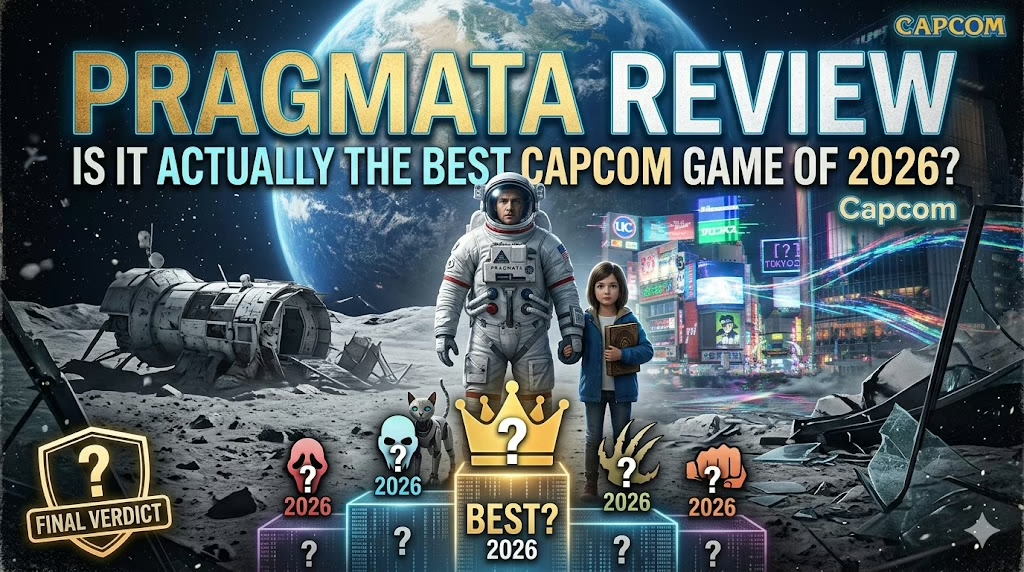
I waited six years for this game. Six. April 17 marks its launch almost six years after it was first revealed back in 2020. I kept telling myself the wait would be worth it because Capcom does not miss. Monster Hunter Wilds. Resident Evil Requiem. Devil May Cry. Street Fighter 6. When this studio commits to something, it usually delivers.
So did Pragmata live up to six years of anticipation?
Mostly. Yeah. With honest caveats I need to address.
This review comes from someone who finished the game twice on two different platforms, explored every side corridor, maxed every upgrade in the Shelter Hub, and hacked every Hack Node I could find. I saw what the game looks like when you rush through it and what it becomes when you take your time. Those are genuinely two different experiences, and I want to talk about both.
What Pragmata Actually Is
Pragmata is a unique, sci-fi action-adventure game from Capcom. You follow Hugh, a member of an ill-fated investigation team, and Diana, a young android, as they navigate a lunar facility taken over by rogue AI in search of a way back to Earth.
That premise sounds straightforward on paper. In practice it is anything but.
At a remote lunar research facility, humanity discovers a new ore that, when properly refined, can be used to create almost anything using 3D printers. When the facility suddenly falls silent, Hugh and his team are dispatched to investigate, but then disaster strikes. Hugh is saved by Diana, a lone android wandering the complex, and the two must join forces to find a way off the moon while working through an AI-controlled facility bent on stopping them.
Third-person action-shooters have been around a long time, so it is relatively rare that we see a wealth of new ideas at play. Pragmata’s greatest feat is successfully introducing a twist on the form, integrating two distinct mechanics, hacking and shooting, that run simultaneously in the midst of a fight.
That is the whole game in one sentence. And it works far better than it has any right to.
The Story and Characters
Hugh and Diana: A Partnership That Actually Functions
The opening hours had me leaning forward in my chair. Capcom nailed the atmosphere in a way I did not fully expect from a brand new IP. Walking through the cold corridors of a lunar research station while rogue AI security systems flicker in and out of active states carries genuine unease. The sound design deserves recognition. The silence of the Moon sections punctuated by mechanical ambience makes every encounter feel consequential.
But what kept me invested was Diana.
I have played a lot of games with AI companion characters. Most are tolerable at best and genuinely annoying at worst. Players have praised the emotional narrative between Hugh and Diana and I understand why. Diana is not following Hugh around making commentary on the environment. She is actively participating in your survival strategy. Her android abilities are woven so deeply into combat and exploration that you constantly approach encounters thinking about what she can do, not just what Hugh can do.
Some dialogue in the middle chapters feels repeated, particularly during the quieter traversal sections. But the story itself takes real swings in its second half. The Moon sections recontextualize what you experienced earlier in meaningful ways. A few twists land hard. One or two needed another draft. But I was engaged from the opening cinematic to the credits, which is more than I can say for most forty-hour experiences.
One important correction from many reviews I have seen: Diana is not a human child. She is an android, and that distinction matters to how the story handles her abilities and her relationship with Hugh. The writing treats it seriously.
Combat: Good, Not Great, But Layered
Here is where honesty is required.
Pragmata’s combat is satisfying but it never reaches the absolute highs of Capcom’s best action games. It is not Devil May Cry. The moment-to-moment tension does not match Resident Evil Requiem either, which you can read more about in our Resident Evil Requiem vs RE4 Remake breakdown.
What it is, though, is versatile. Hugh has guns. Diana has android-specific abilities. The hacking system lets you turn enemy hardware against the facility itself. The game wants you mixing all three systems constantly, and the best encounters are the ones where all three click into place at the same time.
My favorite rooms were those where I hacked a ceiling-mounted turret, had Diana use her ability to disrupt three enemy units simultaneously, and then picked off the staggered targets while the turret covered my flank. When the three systems synchronize, nothing else plays quite like this.
But some encounters fall completely flat. Pure organic enemy rooms where hacking is non-applicable and Diana’s abilities are still on cooldown. In those sections you are just shooting things with gunplay that is functional but not exceptional on its own. Those moments made it clear that Pragmata’s shooting mechanics alone cannot carry a room. The game knows this, which is why it usually avoids leaving you with only one tool. But the occasional slip is noticeable.
The Hacking System Is the Real Star
I cannot overstate this. The hacking system elevates Pragmata from a good sci-fi action game into something genuinely special.
Both Hugh and Diana have their own abilities, and you will need to control them both at the same time to overcome the many obstacles you face. This two-in-one approach, where hacking is key to your success, is Capcom’s own unique take on combat.
Turning drones into kamikaze allies. Disabling enemy shields from thirty meters away. Cutting the lights in a room before moving through undetected. Locking doors behind you to cut off reinforcements. These are not gimmicks. They are core strategies that change how you read every single encounter.
The Shelter Hub upgrade system, Pragmata’s version of a skill tree, transforms how you approach the game over time. Early chapters feel constrained because Hugh’s hack range is short and Diana’s connection speed is slow. By the mid-game with several key upgrades, you feel like a different kind of player entirely. I spent entire encounters in my second playthrough without firing a single bullet. Just hacking. That is not how I expected to engage with a Capcom action game. But it worked brilliantly.
For a full breakdown on every upgrade path and how to prioritize them, our Pragmata hacking system guide covers the whole tree in detail.
Performance and Visuals Across Platforms
Pragmata released on PC, PS5, Xbox Series X/S, and Nintendo Switch 2 on April 17, 2026. I played on PS5 and PC. Here is the honest breakdown.
PS5 holds a clean 60fps in Performance Mode through the majority of the game. The interior lunar station sections are rock solid. The exterior open Moon areas with heavy particle effects and Diana’s hair physics simulation caused occasional frame dips into the mid-50s on my base PS5. Not enough to hurt gameplay but worth noting. Quality Mode targets 30fps with ray tracing and looks genuinely stunning if you can stomach 30 for an action game. I cannot. Personal preference.
The PS5 Pro, with the PSSR upscaling option, cleans up the image significantly, delivering a stable image with crisp quality and great filtering across the board for textures. If you have a PS5 Pro, that is your best console option.
PC ran well on my setup. Using DLSS Quality at 1440p, most indoor areas held consistently above 80fps. The larger exterior Moon environments dropped closer to 65fps but remained smooth. Ray tracing is worth enabling if your GPU can handle it. The reflections in the metal corridors actually have a gameplay function: you can spot enemy unit reflections before turning corners, which feeds directly into the hacking system’s timing windows.
The Xbox Series X version is a good way to play Pragmata, and Quick Resume helps get around the slightly longer load times compared to PS5.
Simple takeaway: PS5 is the most polished, Switch 2 is the most flexible, and Xbox is the most balanced. If you are thinking about a hardware upgrade for games at this level, our best prebuilt gaming PCs guide has current 2026 recommendations.
| Platform | Target Frame Rate | Resolution | Notes |
|---|---|---|---|
| PS5 | 60fps (Performance) | 4K upscaled | Occasional dips in exterior areas |
| PS5 Pro | 60fps+ | Native 4K PSSR | Best console image quality |
| Xbox Series X | 60fps | 1440p upscaled to 4K | Slightly longer load times |
| PC (RTX 4070 Super) | 80–100fps | 1440p DLSS Quality | Best overall if hardware allows |
| Nintendo Switch 2 | 30–60fps (docked) | Dynamic resolution | Impressive for handheld play |
Pragmata vs. Resident Evil Requiem
Both are 2026 Capcom games running on the RE Engine. Both are excellent. But they serve very different purposes, and the comparison that keeps coming up online deserves a direct answer.
You can read our full Pragmata vs Resident Evil Requiem comparison for the deep dive, but here is the short version from someone who completed both.
Pragmata wins on systems depth. The combination of shooting, hacking, and Diana’s android abilities gives you three distinct toolkits to approach any encounter. Requiem is more focused but also more limited in how it lets you express yourself as a player.
Pragmata wins on exploration. The lunar station environments are more varied and more interesting to investigate thoroughly. Side rooms actually reward curiosity with Shelter Hub components and lore. Hidden paths feel genuinely hidden.
Requiem wins on horror and tension. Nothing in Pragmata truly scared me. It unsettled me during a few specific sequences. But Requiem had genuine dread running through every corridor. Different design goals, different results.
Requiem wins on pacing. Pragmata has a slower mid-section around chapters five and six where the story delivers exposition rather than forward momentum. Requiem is tight from opening to credits.
In a gaming landscape that feels dominated by sequels, remakes, and remasters, Pragmata launched and got off to a very strong start, selling more than one million units in its first 48 hours. Capcom later confirmed Pragmata sales rose to two million in 16 days. Both titles are performing well for Capcom in 2026. That is not an accident.
What Holds Pragmata Back
No game is perfect. I want to be direct about the things that kept me from calling this a masterpiece.
Pacing Issues in the Middle Third
Chapters five and six feel stretched. New mechanics stop being introduced. Enemy variety plateaus. The story delivers information dumps instead of pushing the narrative forward. I got through it because I was already invested, but I know people who stepped away during this stretch and did not come back. That is a real problem.
Boss Fights Are Inconsistent
Some boss encounters are exceptional. The mid-game boss that integrates the hacking system in genuinely unexpected ways left me grinning. The spectacle fights are memorable.
But one specific boss in the mid-game is a damage sponge with predictable attack patterns and another in the later chapters leans on trial-and-error memorization rather than skill expression. The inconsistency is frustrating precisely because the highs are so high. When Pragmata’s boss design works, it feels completely unique. When it does not, it feels like a different game.
The Oxygen System Needed More Work
The exterior Moon sections add an oxygen management mechanic. The idea is to create tension during open traversal by limiting your air supply. In practice, it mostly means you sprint between refill stations and cannot explore freely without constantly checking your meter.
I died to oxygen depletion three times during my first playthrough. Not because I was lost. Because I was investigating a side path and ran out of air close to a refill station. That kind of friction fights against the game’s otherwise excellent exploration design. It needed another design pass before release.
New Game Plus Access
You complete the full game before New Game Plus unlocks, which is standard. But New Game Plus adds new Diana abilities and significantly harder enemy configurations that feel like they should have been accessible earlier. Standard difficulty on the base game is easier than I wanted it to be. New Game Plus fixes that, but committing eighteen to twenty hours before unlocking harder content is a meaningful barrier.
How It Compares to Other 2026 Games
2026 has been an unusually strong year for quality single-player releases. Pragmata exists alongside Saros from Housemarque and Crimson Desert, among others. Here is where it actually lands.
For pure replay value, Saros has it beat. The Eclipse System means you are still finding new configurations weeks after your first clear. Pragmata is essentially done after two playthroughs unless you are hunting collectibles or aiming for specific challenge completions. Our Saros Eclipse System guide breaks down why that loop works so well if you are playing both.
For open-world exploration, Crimson Desert offers more freedom. Pragmata’s semi-linear structure is tighter and more directed, which is sometimes exactly what you want and sometimes a limitation depending on your preference. Our Crimson Desert beginner guide is worth reading if you are juggling both.
For story and atmosphere, Pragmata wins the year. Nothing else released in 2026 delivered the specific brand of isolation and unease that navigating a rogue AI-controlled lunar facility provides. The visual storytelling is exceptional and the relationship between Hugh and Diana carries genuine emotional weight by the final act.
| Game | Story Depth | Combat Replay | Pacing | Atmosphere |
|---|---|---|---|---|
| Pragmata | ★★★★★ | ★★★☆☆ | ★★★☆☆ | ★★★★★ |
| Resident Evil Requiem | ★★★★☆ | ★★★★☆ | ★★★★★ | ★★★★★ |
| Saros (Housemarque) | ★★★☆☆ | ★★★★★ | ★★★★☆ | ★★★★☆ |
| Crimson Desert | ★★★★☆ | ★★★★☆ | ★★★☆☆ | ★★★★☆ |
Should You Buy Pragmata Right Now?
Yes. With a specific asterisk depending on what you want from it.
If you enjoy exploration-driven games with layered combat systems and a story that rewards patience, buy it today. The first two hours will hook you hard. The back half of the game will reward you for getting through the slower middle chapters.
If you need constant high-intensity action and prefer tight pacing throughout, wait for a sale or play knowing the mid-section requires some patience to push through.
PC players: the port is genuinely good. No major stuttering beyond standard shader compilation in the opening minutes, which is becoming the industry norm. Capcom delivered a clean PC launch. According to the official Pragmata Steam store page, the vast majority of recent user reviews are positive, which matches my personal experience across both playthroughs.
If you end up loving the game, commit to the hacking system fully. Most players treat it as a secondary option. It is not. It is where Pragmata’s real identity lives. Our Pragmata beginner’s guide will help you get the most from both Hugh’s toolkit and Diana’s android abilities from the very first chapter.
The Verdict
Pragmata can be completed in a weekend by a dedicated player, and the latter beats of its story will more than likely leave you emotionally invested. This is the type of game that used to be Capcom’s bread and butter.
The hacking system gives players genuine creative freedom in combat. Diana is a companion who enhances gameplay rather than hindering it. The atmosphere and visual design are among the best the RE Engine has produced. The title stands out by departing from Capcom’s reliance on established franchises, allowing the development team to explore new mechanical territory.
It stumbles in its middle chapters. Some boss fights disappoint. The oxygen mechanic on the exterior Moon sections needed one more design revision. But the overall package is something I will still be thinking about months from now, and that counts for more than any individual flaw.
Is it the best Capcom game of 2026? For me, yes. Not their most mechanically polished. Not their most replayable. But the one that stuck longest after the credits rolled. The one that made me reconsider how companion AI can function in an action game. That is worth something.
Score: 8.5/10
| Category | Rating |
|---|---|
| Story and Atmosphere | 9/10 |
| Combat Systems | 7.5/10 |
| Hacking Mechanics | 9/10 |
| Pacing | 7/10 |
| Visuals and Performance | 9/10 |
| Replayability | 7/10 |
| Overall | 8.5/10 |
Also playing Saros alongside this? Our Saros beginner tips and best weapons guide will save you hours of early frustration in Housemarque’s roguelite.
Frequently Asked Questions
How long is Pragmata?
A focused first playthrough takes 18 to 22 hours depending on how much side content you pursue. Completionist runs with all collectibles run closer to 30 to 35 hours. New Game Plus adds another 12 to 18 hours with new Diana abilities and harder enemy variants.
Is Pragmata open world?
No. It uses a semi-linear structure with large explorable zones connected by story progression. You can revisit previous areas via fast travel but the game funnels you through chapters in order. Think more Metroidvania-adjacent than open world.
What platforms is Pragmata on?
Pragmata was released for PlayStation 5, Windows, Xbox Series X/S, and Nintendo Switch 2 on April 17, 2026. There are no last-gen versions.
Is Pragmata a horror game?
No. It has unsettling moments and a consistently dark atmosphere, but it is not survival horror. Think sci-fi thriller with strong action elements rather than Resident Evil-style fear. The tone is closer to a tense science fiction film than a horror experience.
Who are the main characters in Pragmata?
The game follows spacefarer Hugh Williams and an android named Diana as they attempt to escape from the hostile artificial intelligence IDUS and return to Earth together. Diana is an android companion, not a human child, and that distinction is important to both the story and how her abilities function in gameplay.
Can you play Pragmata without using the hacking system?
Technically yes. You can shoot your way through most encounters. But the game is significantly less interesting without it. The hacking system is designed as a core mechanic, not a bonus feature, and the Shelter Hub upgrade tree rewards investing in it heavily.
Does Pragmata have multiplayer?
No. It is entirely single-player. Diana is an AI companion controlled through contextual commands and ability triggers during combat.
Is it better than Resident Evil Requiem?
Different games designed for different priorities. Pragmata has more mechanical depth and creative ambition. Requiem has tighter pacing and more consistent tension from start to finish. Both are excellent 2026 Capcom titles worth your time.
Last Updated: August 2026
About the Author: I cover action games, PC hardware, and gaming deep-dives for TechsNGames. I have been writing about Capcom games since Resident Evil 7 and have tested titles across PS5, PC, and handheld platforms. When I say I played something twice, I mean it.